

European Exhibition Tent Standards: EN 13782 Compliance Guide
Exhibition tents account for a significant portion of the temporary structures market across Europe, with EN 13782 standards serving as the cornerstone for safety compliance. If you are organizing trade shows, exhibitions, or corporate events in the UK, Germany, France, or other European nations, understanding these regulatory requirements isn't optional—it's essential for legal operation and attendee safety.
In this comprehensive guide, we will break down EN 13782 compliance requirements, fire safety certifications, wind load calculations, installation permits, and insurance obligations. This article draws from current industry practice and regulatory frameworks to help event planners and exhibition organizers navigate European tent standards with confidence.
Table of Contents
- 1. What Is EN 13782 and Why It Matters
- 2. Scope and Application of EN 13782
- 3. Core Safety Requirements Under EN 13782
- 4. Fire Safety Certifications for Exhibition Tents
- 5. Wind Load Ratings and Structural Calculations
- 6. Installation Permits Across European Countries
- 7. Insurance Requirements for Exhibition Structures
- 8. Country-Specific Compliance: UK, Germany, and France
- 9. Documentation and Certification Process
- 10. FAQ: EN 13782 Compliance Questions
- 11. Conclusion
What Is EN 13782 and Why It Matters
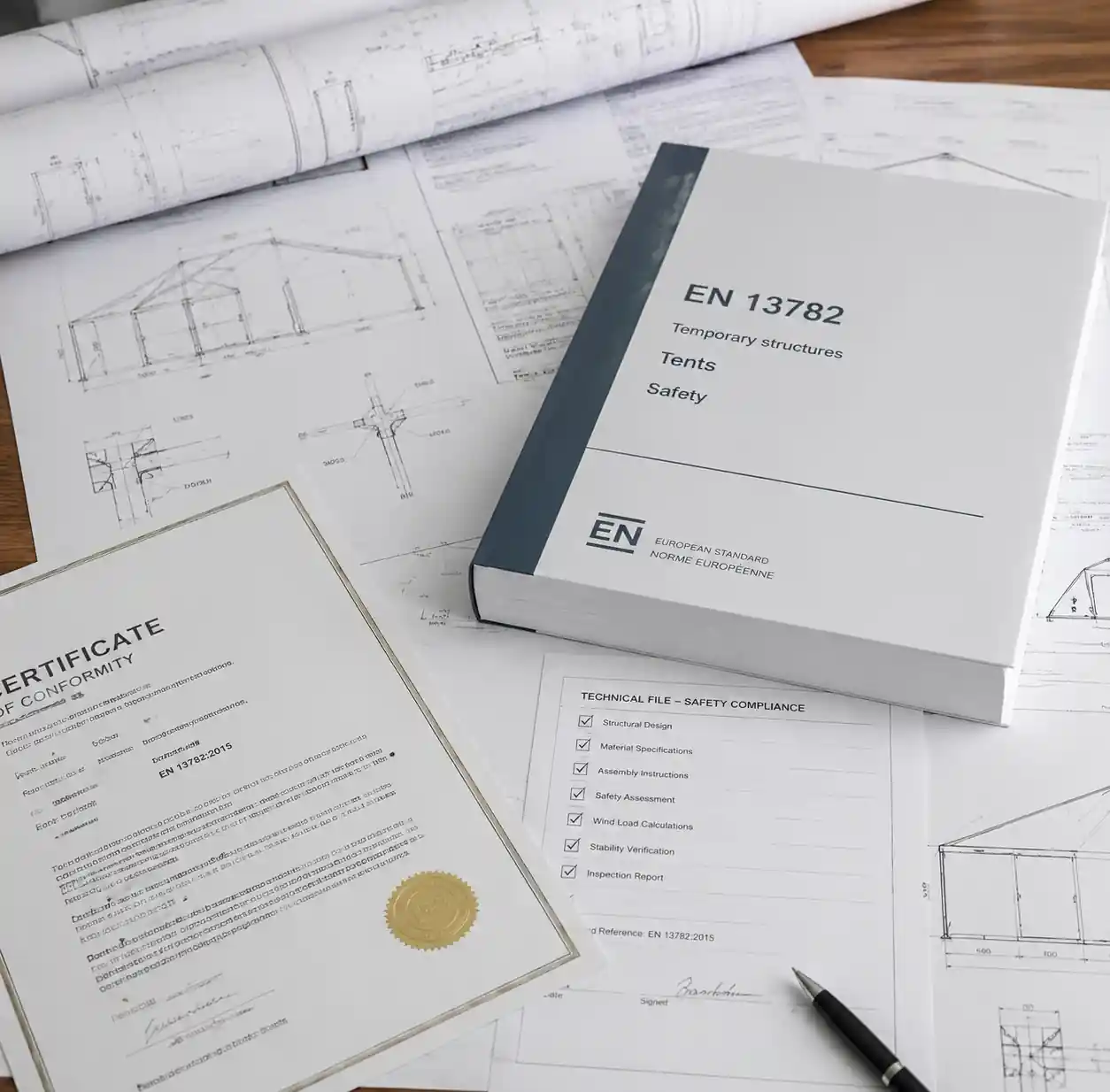 EN 13782 European Tent Standard Certification Documentation
EN 13782 is the European standard titled "Temporary structures – Tents – Safety" that specifies safety requirements for the design, calculation, manufacture, installation, and maintenance of mobile temporary tents with ground areas exceeding 50 m². This standard applies to [exhibition marquees](/ exhibition-solution.html), trade show structures, and event tents used across the European Union.
The standard was approved by CEN (European Committee for Standardization) and ensures that temporary structures meet consistent safety benchmarks. For exhibition organizers, compliance with EN 13782 means your tent installation meets structural integrity requirements, fire safety protocols, and operational safety guidelines recognized across EU member states.
You need EN 13782 compliance because most European venues, insurance providers, and local authorities require it before approving temporary structure installations. Without proper certification, you risk event cancellation, liability exposure, and financial penalties.
Scope and Application of EN 13782
The standard applies specifically to:
- Temporary tents with ground areas greater than 50 m²
- Mobile structures designed for repeated installation and dismantling
- Exhibition halls, trade show tents, and temporary exhibition structures
- Tents used at fairs, festivals, and commercial events
EN 13782 does not cover permanent structures, residential camping tents under 50 m², or inflatable structures. For structures below the 50 m² threshold, simplified documentation requirements apply, though safety principles remain relevant.
The standard addresses the complete lifecycle: design calculations, manufacturing quality, installation procedures, maintenance protocols, operational safety, and periodic inspections. This comprehensive approach ensures that every phase of tent deployment meets safety benchmarks.
Core Safety Requirements Under EN 13782
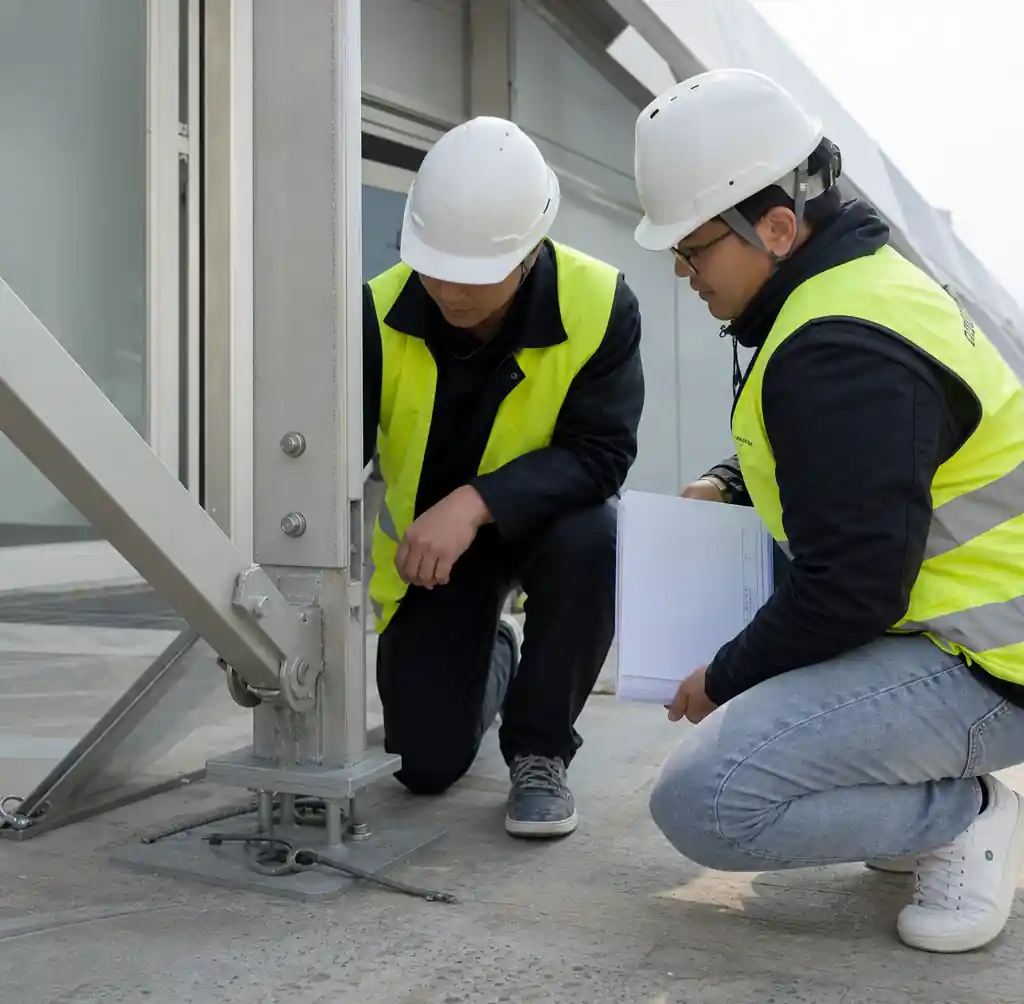 Exhibition Tent Structural Safety Inspection
According to EN 13782 safety requirements, exhibition tents must satisfy several critical safety criteria:
Structural Stability: Tents must withstand specified loads including dead loads (structural weight), live loads (occupants and equipment), wind loads, and snow loads where applicable. Structural calculations must follow Eurocode principles.
Anchoring Systems: Ground anchoring must provide adequate resistance against uplift and overturning forces. Soil conditions, anchor types, and safety factors must be documented.
Material Specifications: Frame materials (typically aluminum or steel) and fabric coverings must meet specified strength and durability requirements. All materials require testing certificates.
Emergency Egress: Exhibition tents must provide adequate emergency exits based on occupant capacity, with clear escape routes and appropriate signage.
Operational Limits: Manufacturers must specify maximum wind speeds, temperature ranges, and occupancy limits. Event organizers must monitor conditions and evacuate if limits are exceeded.
The table below compares key requirements for different tent sizes:
| Tent Size | Structural Calculations | User Manual Required | Inspection Frequency | Maximum Occupancy Calculation |
|---|---|---|---|---|
| < 50 m² | Simplified documentation | No | Annual | 0.5 person/m² |
| 50-500 m² | Full engineering calculations | Yes | Every 6 months | Per egress analysis |
| > 500 m² | Detailed structural analysis | Yes with emergency plans | Every 3 months | Per local fire code |
Fire Safety Certifications for Exhibition Tents
Fire safety represents one of the most critical compliance areas for exhibition tents. European regulations require flame-retardant materials and proper fire safety protocols.
Fabric Fire Classifications: Tent fabrics must meet European fire classification standards. The most common requirement is Class B-s1, d0 or better under EN 13501-1. This classification indicates limited flammability, minimal smoke production, and no flaming droplets.
Fire Load Calculations: Event organizers must calculate total fire load based on tent materials, exhibition stands, and displayed products. High fire loads trigger additional safety requirements such as fire watch personnel or suppression systems.
Fire Safety Equipment: Exhibition tents require:
- Portable fire extinguishers (minimum 6 kg capacity per 200 m²)
- Clearly marked emergency exits
- Emergency lighting systems
- Fire detection systems for tents exceeding 1000 m²
According to CFPA Europe Guidelines, event organizers should conduct fire risk assessments before installation and maintain fire safety logs throughout the event duration.
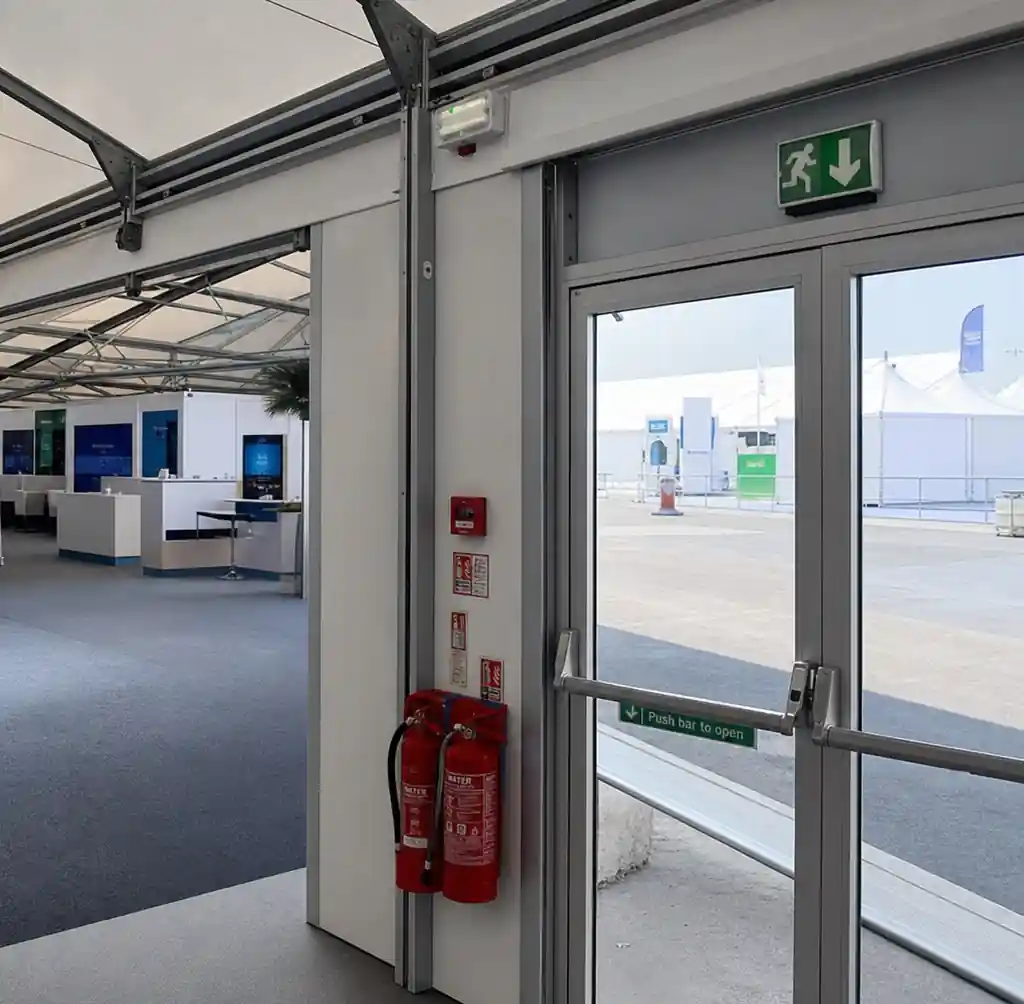 Fire Safety Equipment in Exhibition Tent
Wind Load Ratings and Structural Calculations
Wind load resistance is fundamental to tent safety. EN 13782 requires structural calculations based on local wind zone classifications and site-specific conditions.
Wind Zone Classification: Europe uses wind zone maps based on Eurocode EN 1991-1-4. Wind speeds vary significantly—coastal areas and mountainous regions experience higher loads than inland valleys. Your structural engineer must reference the specific wind zone for your installation site.
Safety Factors: EN 13782 mandates minimum safety factors of 1.5 for permanent loads and 2.0 for temporary installations. These factors account for material variability, installation quality, and unforeseen conditions.
Wind Speed Thresholds: Most exhibition tents are designed for sustained wind speeds of 80-100 km/h, with gust resistance up to 120 km/h. However, operational limits are typically set lower—many venues require evacuation when wind gusts exceed 70-80 km/h.
According to YourEurope weather hazard guidelines, safe wind thresholds must be defined in terms of gust speeds, not just hourly averages. Real-time weather monitoring is essential during events.
The following table outlines typical wind load requirements:
| Wind Zone | Basic Wind Speed (m/s) | Tent Design Pressure (kPa) | Typical Applications | Anchoring Requirements |
|---|---|---|---|---|
| Zone 1 (Inland) | 22-24 | 0.6-0.8 | Most exhibitions | Standard ground anchors |
| Zone 2 (Moderate) | 24-26 | 0.8-1.0 | Exposed sites | Reinforced anchoring |
| Zone 3 (Coastal) | 26-28 | 1.0-1.3 | Coastal exhibitions | Heavy-duty anchors + ballast |
| Zone 4 (High) | >28 | >1.3 | Mountain/exposed areas | Engineering-specific solutions |
Installation Permits Across European Countries
Permit requirements vary by country and municipality, but most European jurisdictions require approval before installing exhibition tents exceeding 50 m².
United Kingdom: Local councils typically require temporary structure permits under the Building Act 1984. Applications must include structural calculations, fire safety plans, and public liability insurance certificates. Processing times range from 4-8 weeks depending on the authority.
Germany: German regulations (Versammlungsstättenverordnung) classify large exhibition tents as temporary assembly spaces. Permits require approval from local building authorities (Bauaufsichtsbehörde), with particular scrutiny on fire safety and structural engineering. TÜV certification is commonly required.
France: French law requires a déclaration préalable de travaux for temporary structures exceeding 50 m². Exhibition tents in public spaces need additional authorization from local préfecture. Fire safety must comply with ERP (Établissements Recevant du Public) regulations.
Processing Timelines: Plan for 6-12 weeks for permit approval in major European cities. Rush permits are possible but involve higher fees and limited availability.
 Exhibition Tent Installation Permit Application Process
You should engage local permit expeditors or specialized exhibition contractors familiar with regional requirements. Many exhibition venues handle permitting as part of their site package, simplifying the process.
Insurance Requirements for Exhibition Structures
Exhibition tent installations require comprehensive insurance coverage across Europe. Venue operators and local authorities typically mandate minimum coverage levels before approving installations.
Public Liability Insurance: Most European venues require minimum coverage of €5,000,000 for combined bodily injury and property damage. Some jurisdictions, particularly in Germany and the UK, may require higher limits for large-scale exhibitions.
Event Cancellation Insurance: Weather-related cancellations represent significant financial risks. Event organizers should consider policies covering adverse weather, structural failure, and permit denials.
Contractor All-Risk Insurance: Covers damage during installation and dismantling phases. This protects against equipment damage, third-party claims, and worker injuries.
According to exhibition insurance documentation, insurance policies must name the venue operator and local authorities as additional insured parties. Coverage must extend from installation commencement through complete dismantling.
 Exhibition Tent Insurance Certificate and Coverage Documentation
Country-Specific Compliance: UK, Germany, and France
While EN 13782 provides a harmonized framework, each European country applies additional national requirements.
United Kingdom Specifics:
- Health and Safety Executive (HSE) guidance applies to all temporary structures
- The Construction (Design and Management) Regulations 2015 require principal designer appointments for complex installations
- Wind load calculations must reference BS EN 1991-1-4 with UK National Annex
- Fire safety must comply with the Regulatory Reform (Fire Safety) Order 2005
Germany Specifics:
- Versammlungsstättenverordnung (assembly venue regulations) vary by state (Bundesland)
- TÜV inspection and certification commonly required for tents exceeding 200 m²
- Strict fire safety requirements including fire watch personnel during events
- Detailed evacuation plans with capacity calculations mandatory
France Specifics:
- Code de la construction et de l'habitation governs temporary structures
- ERP classification determines fire safety and accessibility requirements
- Bureau de contrôle inspection often required for structures exceeding 300 m²
- Stricter requirements apply in historic city centers and protected zones
You can work with local exhibition contractors like Velaria Spatia who maintain expertise in country-specific regulations and established relationships with local authorities.
Documentation and Certification Process
EN 13782 compliance requires extensive documentation. Essential documents include:
Manufacturer Documentation:
- Design calculations signed by qualified structural engineer
- Material certificates for frame and fabric components
- Load tables specifying maximum wind, snow, and occupancy loads
- User manual with installation, maintenance, and operational instructions
Installation Documentation:
- Site-specific installation drawings
- Soil investigation reports and anchor pull-test results
- As-built documentation showing actual configuration
- Pre-event inspection reports
Operational Documentation:
- Daily safety checklists during event operation
- Weather monitoring logs
- Incident reports for any structural issues
- Post-event inspection reports
Certification bodies such as TÜV, Bureau Veritas, or SGS can provide third-party verification of EN 13782 compliance. While not always legally required, third-party certification significantly simplifies permit applications and insurance procurement.
You should maintain a compliance binder containing all documentation, readily accessible to venue operators, insurance adjusters, and regulatory inspectors.
FAQ: EN 13782 Compliance Questions
What is the minimum tent size requiring EN 13782 compliance?
EN 13782 applies to temporary tents with ground areas exceeding 50 m². Tents below this threshold require simplified documentation but should still follow basic safety principles. However, many venues and insurers apply EN 13782 standards regardless of size.
How long does EN 13782 certification take?
The certification timeline depends on tent complexity and documentation completeness. Simple A-frame tent structures with standard configurations can achieve certification within 4-6 weeks. Custom exhibition structures requiring detailed engineering analysis may require 8-12 weeks. Starting the process early in your event planning timeline is essential.
Do I need separate certifications for each European country?
EN 13782 is a harmonized European standard recognized across EU member states. However, you must still obtain local installation permits and comply with national building codes and fire safety regulations. A single EN 13782 certification simplifies compliance but doesn't eliminate country-specific requirements.
What are the penalties for non-compliance?
Non-compliance can result in immediate event shutdown, fines ranging from €5,000 to €50,000 depending on jurisdiction, civil liability for injuries or damages, and criminal prosecution in cases of gross negligence. Insurance claims may be denied if structures don't meet EN 13782 requirements.
Can I use the same tent certification for multiple events?
Yes, manufacturer certifications remain valid provided the tent configuration hasn't changed and regular inspections are current. However, each installation site requires new site-specific documentation including ground conditions, local wind loads, and installation-specific safety plans.
Who is responsible for EN 13782 compliance—the tent supplier or event organizer?
Responsibility is shared. Tent manufacturers must design and certify structures to EN 13782 standards. Installation contractors must follow manufacturer specifications and create site-specific safety documentation. Event organizers are ultimately responsible for ensuring all parties maintain compliance and securing necessary permits and insurance.
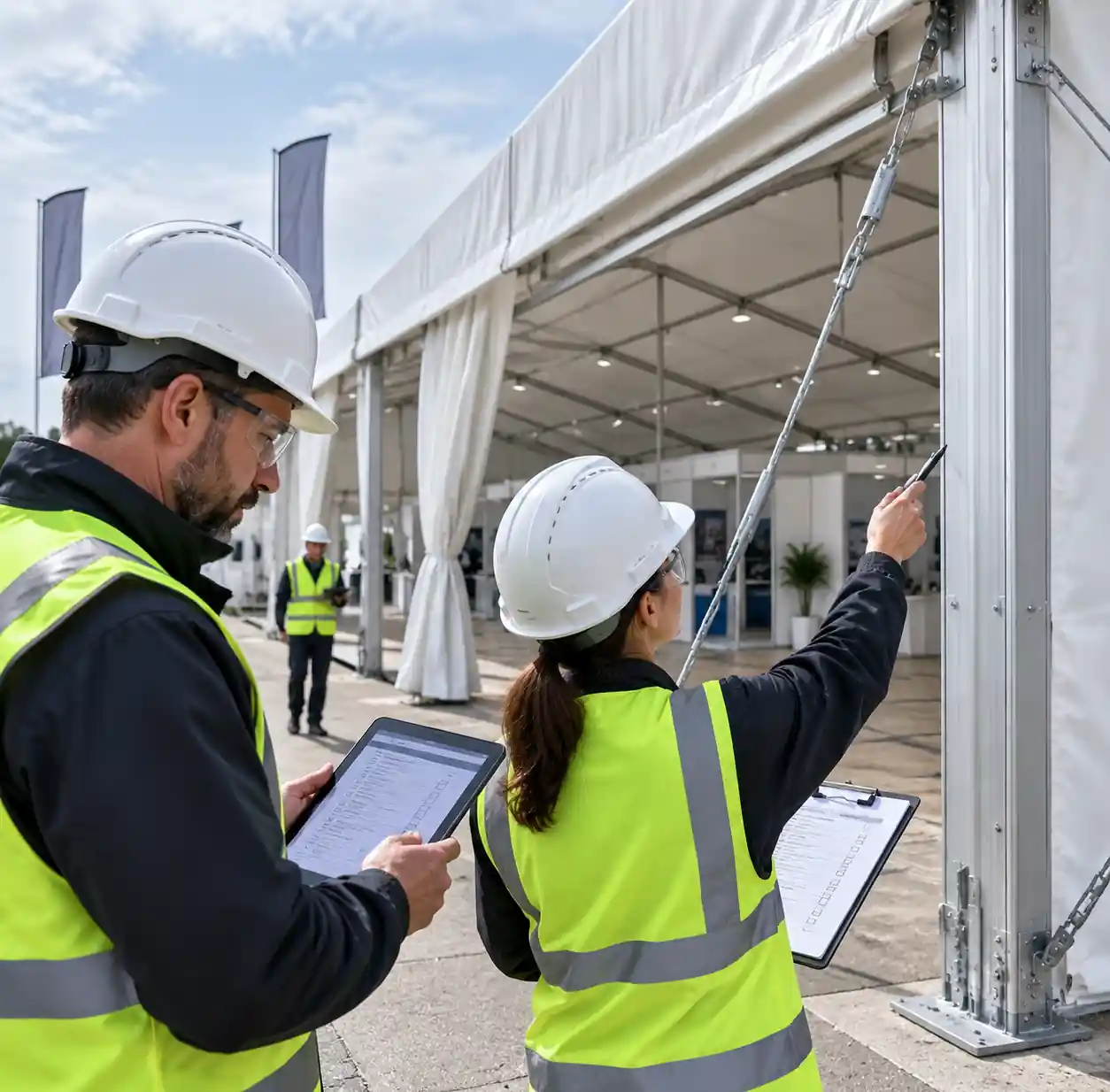 Exhibition Tent Site Inspection Checklist
Conclusion
EN 13782 compliance represents the foundation of safe exhibition tent operations across Europe. Understanding the standard's requirements—from structural calculations and fire safety to wind load ratings and insurance obligations—protects both event organizers and attendees while ensuring regulatory approval.
The complexity of European tent standards varies significantly by country, with the UK, Germany, and France each applying additional national requirements beyond the baseline EN 13782 framework. Successful compliance requires early planning, qualified engineering support, and thorough documentation throughout the installation lifecycle.
For exhibition organizers, partnering with experienced tent suppliers who maintain EN 13782 certification and understand country-specific regulations significantly reduces compliance risks. Weather monitoring, regular inspections, and operational discipline during events ensure that certified structures perform as designed.
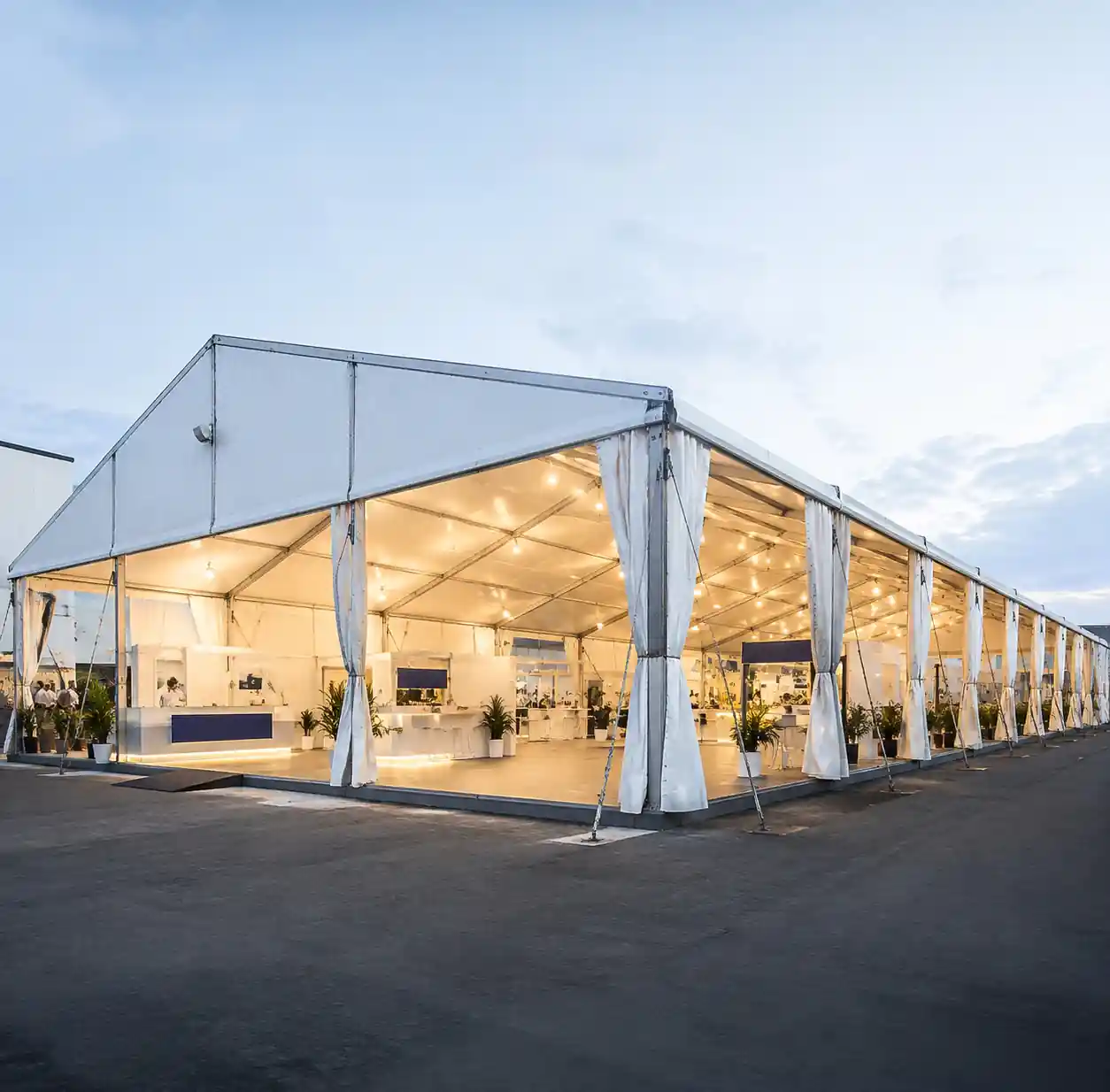 Large Exhibition Tent EN 13782 Compliant Setup
If you need EN 13782-compliant exhibition tents for your European trade shows and events, Velaria Spatia offers fully certified temporary structures with comprehensive engineering support. Our exhibition marquees meet all European safety standards, with documented compliance for the UK, Germany, France, and other EU markets. We provide complete documentation packages including structural calculations, fire safety certifications, and installation support to streamline your permit applications.
Contact us today for EN 13782-compliant exhibition solutions and technical consultation for your next European event.
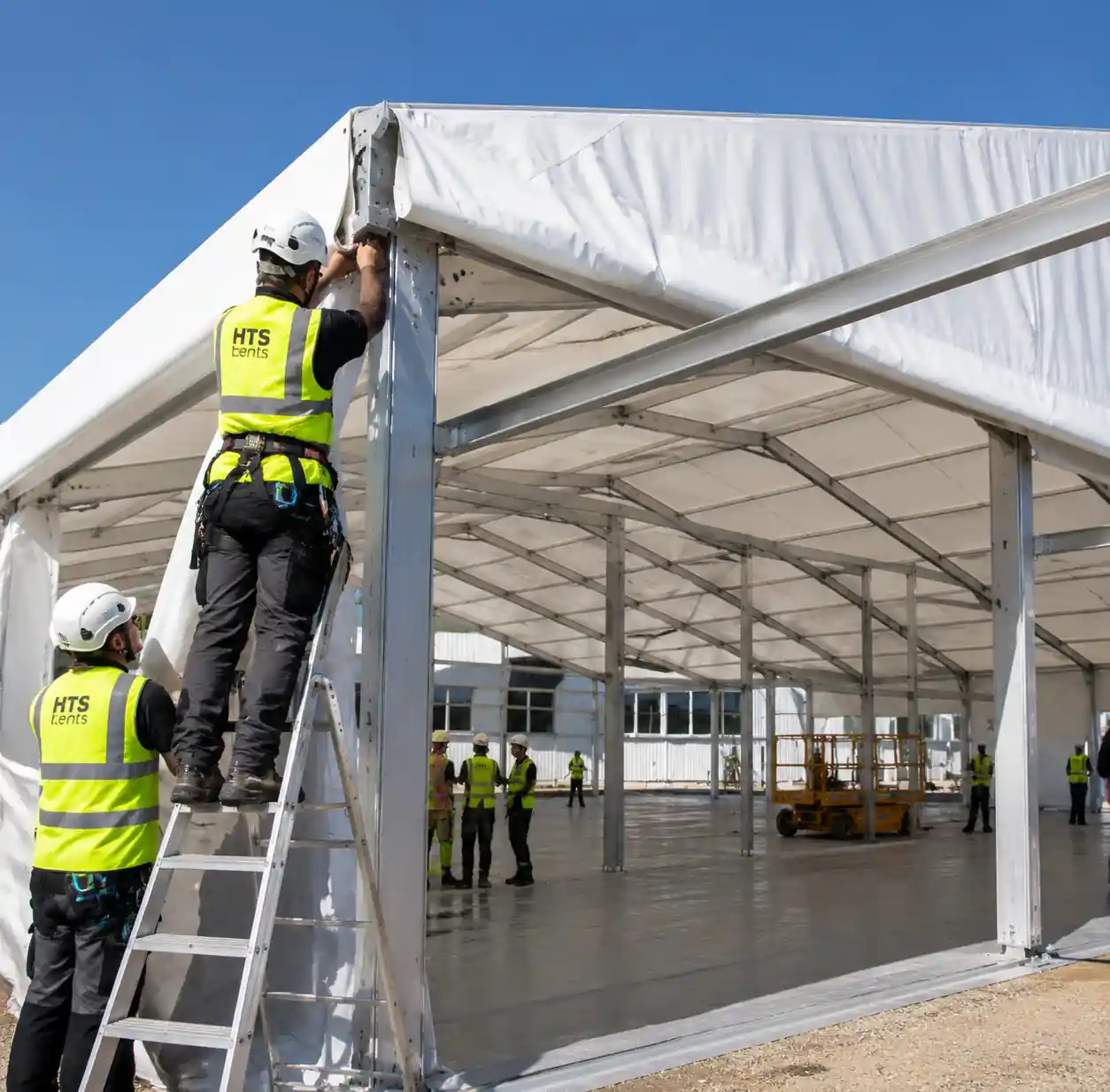 Professional Exhibition Tent Installation by Certified Manufacturer