


Brand Activation Roadshow: Mobile Tent Solutions Guide
Running brand activations across multiple cities without consistent execution costs more than logistics. I've consulted on campaigns where identical booth designs arrived in different markets with mismatched components, delayed permits stalled launches, and structural failures occurred because local crews didn't understand the engineering. These failures share one root cause: treating mobile marketing as a simple replication exercise instead of engineered deployment.
This guide covers the logistics, structural requirements, and operational systems that separate successful multi-city campaigns from expensive disasters. You'll learn transport optimization strategies, rapid deployment protocols, and permit management workflows proven across 50+ market launches.
Table of Contents
- Understanding Mobile Roadshow Infrastructure Requirements
- Selecting the Right Tent Structure for Multi-City Campaigns
- Transport and Logistics Optimization
- Rapid Setup and Breakdown Protocols
- Branding Customization and Visual Consistency
- Multi-City Permit Management
- Staff Training and Quality Control
- Cost Analysis and ROI Optimization
- FAQ
- Conclusion
1. Understanding Mobile Roadshow Infrastructure Requirements
Brand roadshows demand structures surviving repeated assembly cycles across varying ground conditions and weather zones. Standard event tents fail after 3-5 deployments because connection points fatigue and components misalign.
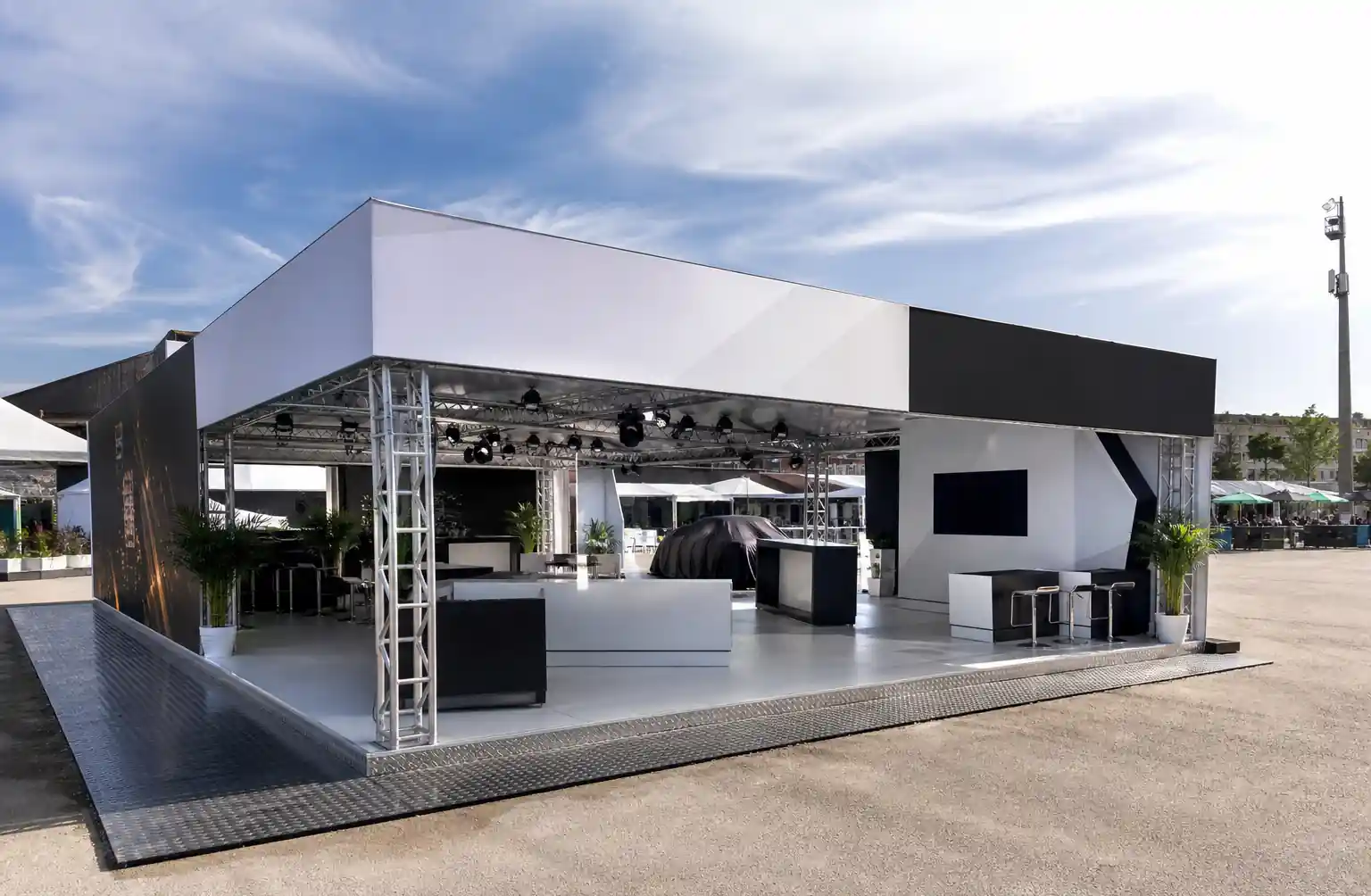 Professional roadshow tent structure designed for multi-city brand activation campaigns
Mobile marketing infrastructure requires frame systems rated for 20+ assembly cycles, modular components fitting standard shipping pallets, weather resistance across temperature ranges (-5°C to 40°C), and multi-surface adaptability. Campaigns covering 10+ cities average 15-20 deployment cycles annually.
| Requirement | Standard Tent | Roadshow Solution | Impact |
|---|---|---|---|
| Assembly Cycles | 3-5 maximum | 20+ rated | Prevents mid-tour failure |
| Transport Volume | 8-12 m³ per 50 sqm | 4-6 m³ per 50 sqm | 40-60% shipping savings |
| Setup Time | 6-8 hours | 2-4 hours | Same-day deployment |
| Ground Adaptability | Single system | Multi-surface | Works all venue types |
For campaigns spanning multiple climate zones, specify structures meeting EN 13782 wind standards with UV-resistant fabrics (minimum 850g/sqm PVC). Our brand roadshow solutions incorporate these specifications with documented protocols.
2. Selecting the Right Tent Structure for Multi-City Campaigns
Structure selection determines transport costs, setup efficiency, and visual impact. Three architectures suit roadshow applications with distinct advantages.
| Structure Type | Setup Time | Transport | Visual Impact | Best Application |
|---|---|---|---|---|
| Pagoda Tent | 2-3 hours | Excellent | Distinctive peak | Product launches, VIP zones |
| Geodesic Dome | 4-6 hours | Compact | Exceptional | Experiential campaigns |
| A-Frame Tent | 3-5 hours | Very good | Professional | Corporate roadshows |
Pagoda tents offer modular flexibility. The 5m × 5m system scales from 25 sqm to 200+ sqm by connecting units. Each packs into 2.2 m³, fitting six per 20-foot container. Ideal for daily relocation tours.
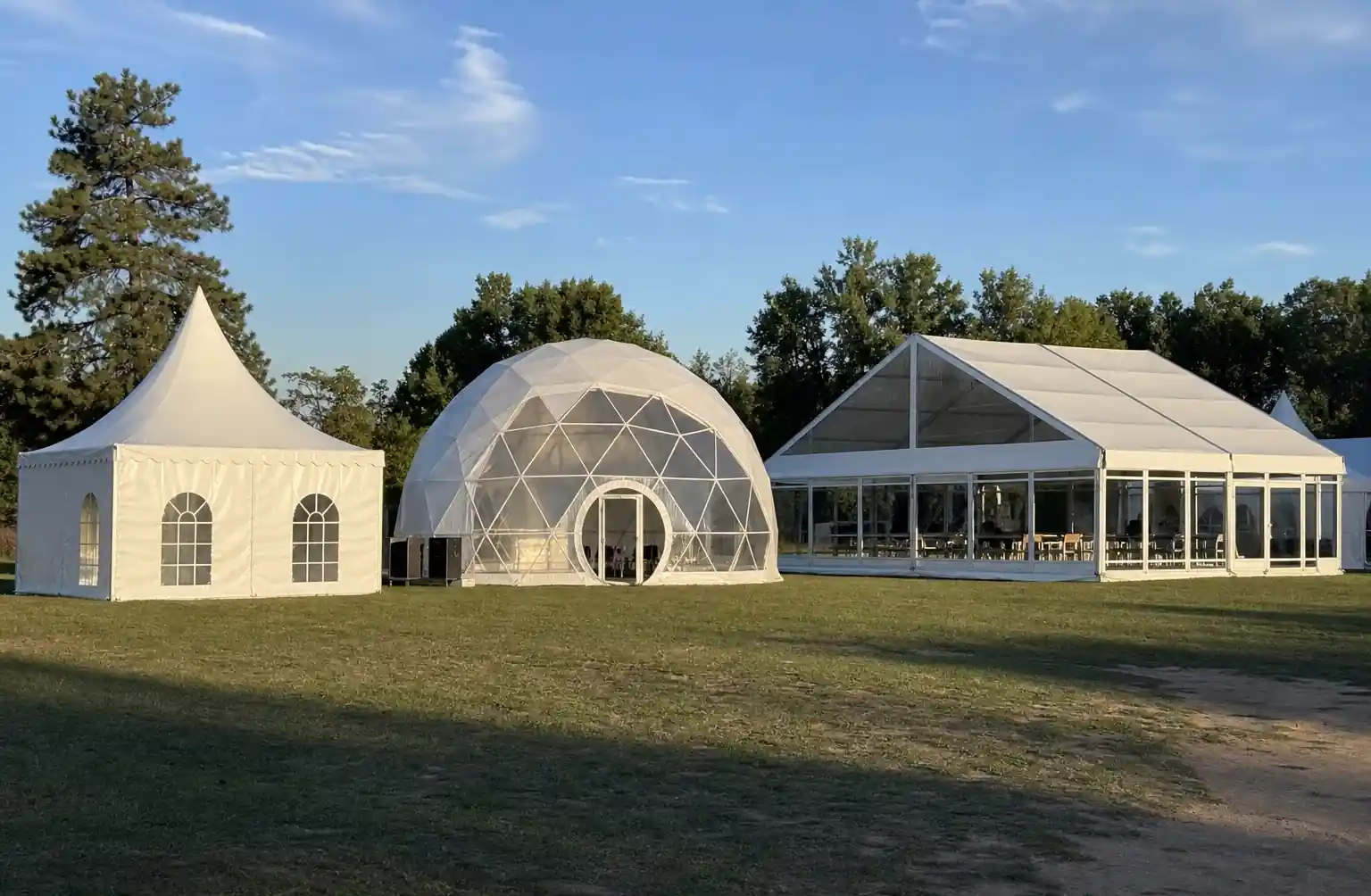 Different tent structure types suitable for mobile brand roadshow campaigns
Geodesic domes deliver brand recognition through distinctive geometry. A 10m diameter dome provides 360-degree branding visible from 200+ meters with 5.8 m³ transport volume. Wind resistance exceeding 120 km/h suits outdoor festivals. Our geodesic dome tents feature tool-free, color-coded assembly.
A-frame structures balance aesthetics with efficiency. Clear-span interiors maximize display space. A 150 sqm unit packs into 7.5 m³, requiring four crew and 3-4 hours setup.
3. Transport and Logistics Optimization
Transport costs consume 25-40% of roadshow budgets when poorly managed. Efficient campaigns optimize packing density, route sequencing, and customs procedures.
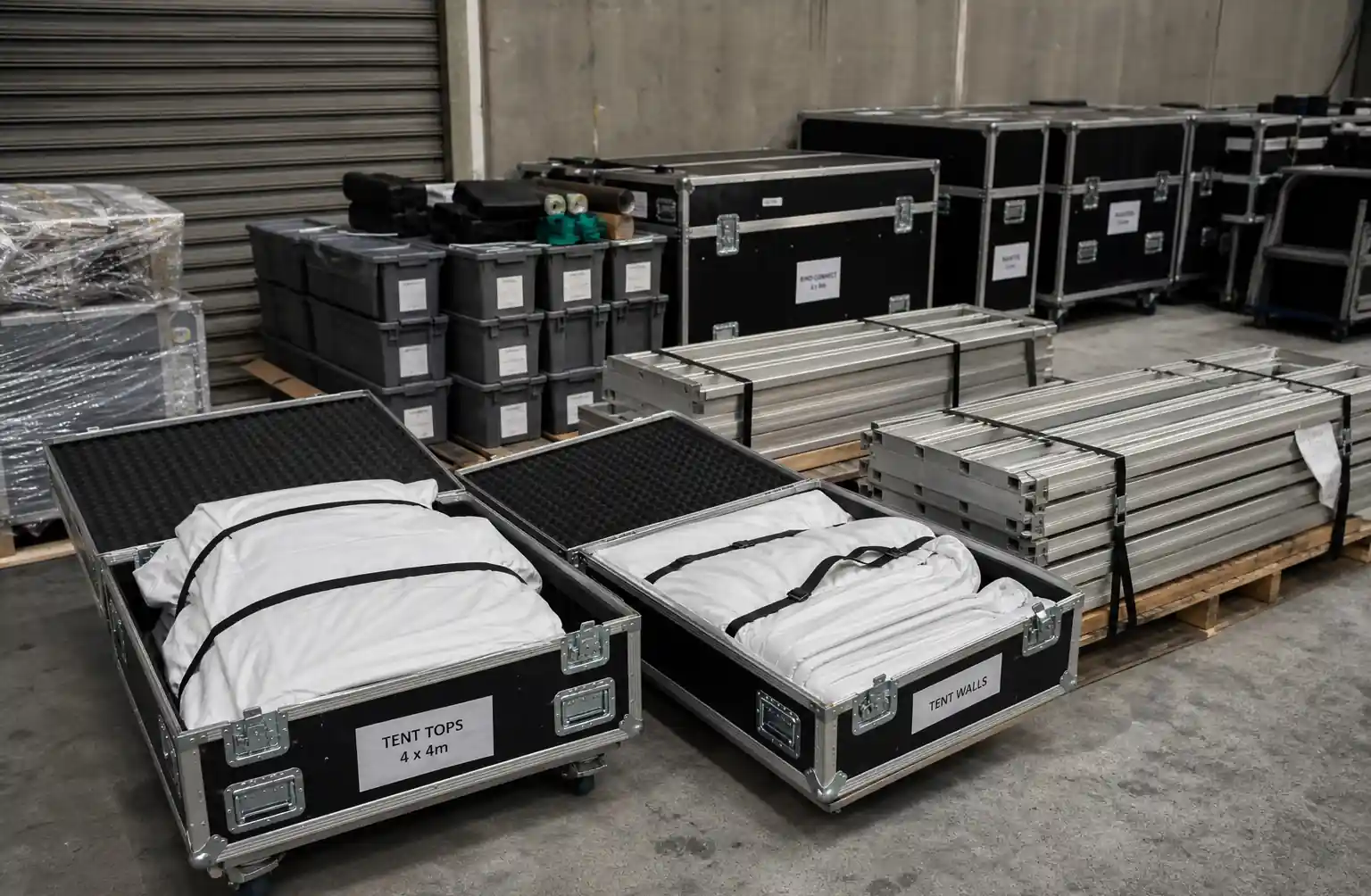 Tent components packed for efficient transport between roadshow locations
Calculate total tour volume before selecting structures. A 12-city tour using 150 sqm tents generates 16 m³ total (tent + flooring + furniture + AV). This fits one 20-foot container, enabling pre-positioned equipment arrival.
Route sequencing reduces backtracking. Plot stops geographically, then sequence chronologically minimizing inter-city distances. Poor sequencing adds 2,000+ km unnecessary transport versus optimized routing.
| Region | Key Challenge | Solution | Lead Time |
|---|---|---|---|
| Europe | Border crossings | ATA Carnet temporary imports | 3-4 weeks |
| Africa | Port delays | Pre-cleared agents, local warehousing | 6-8 weeks |
| Southeast Asia | Varied regulations | Country-specific permits | 4-6 weeks |
For international tours, arrange ATA Carnet documentation allowing duty-free temporary imports across 80+ countries. Processing requires 3-4 weeks. Without carnets, equipment faces 15-30% import duties at borders.
4. Rapid Setup and Breakdown Protocols
Setup speed determines whether activations open on schedule. Professional operations achieve 3-4 hour deployment through documented procedures and trained crews.
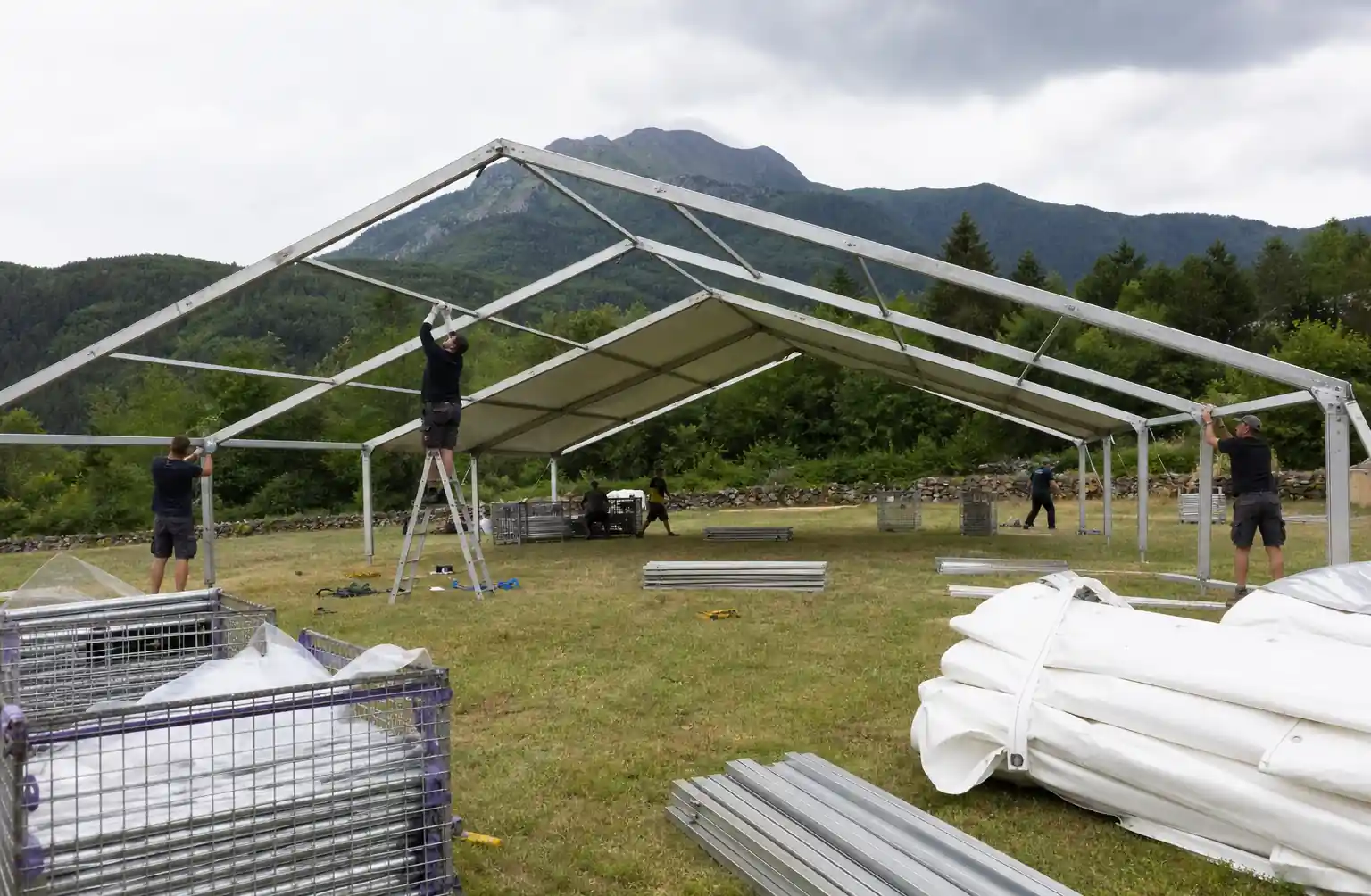 Professional crew performing rapid tent setup for brand activation roadshow
Standardize setup sequences across markets. Document every step photographically, creating visual assembly guides eliminating language barriers. Color-code components matching frame positions, reducing assembly errors.
4-Hour Setup Timeline (150 sqm):
- Hour 0-1: Site survey, ground prep, staging
- Hour 1-2: Frame assembly, roof installation
- Hour 2-3: Sidewalls, flooring, furniture
- Hour 3-4: Branding, lighting, inspection
A 150 sqm structure requires minimum four experienced installers plus supervisor. Reducing crew extends setup to 5-6 hours. Breakdown requires 2.5-3 hours for systematic disassembly, cleaning, and packing.
5. Branding Customization and Visual Consistency
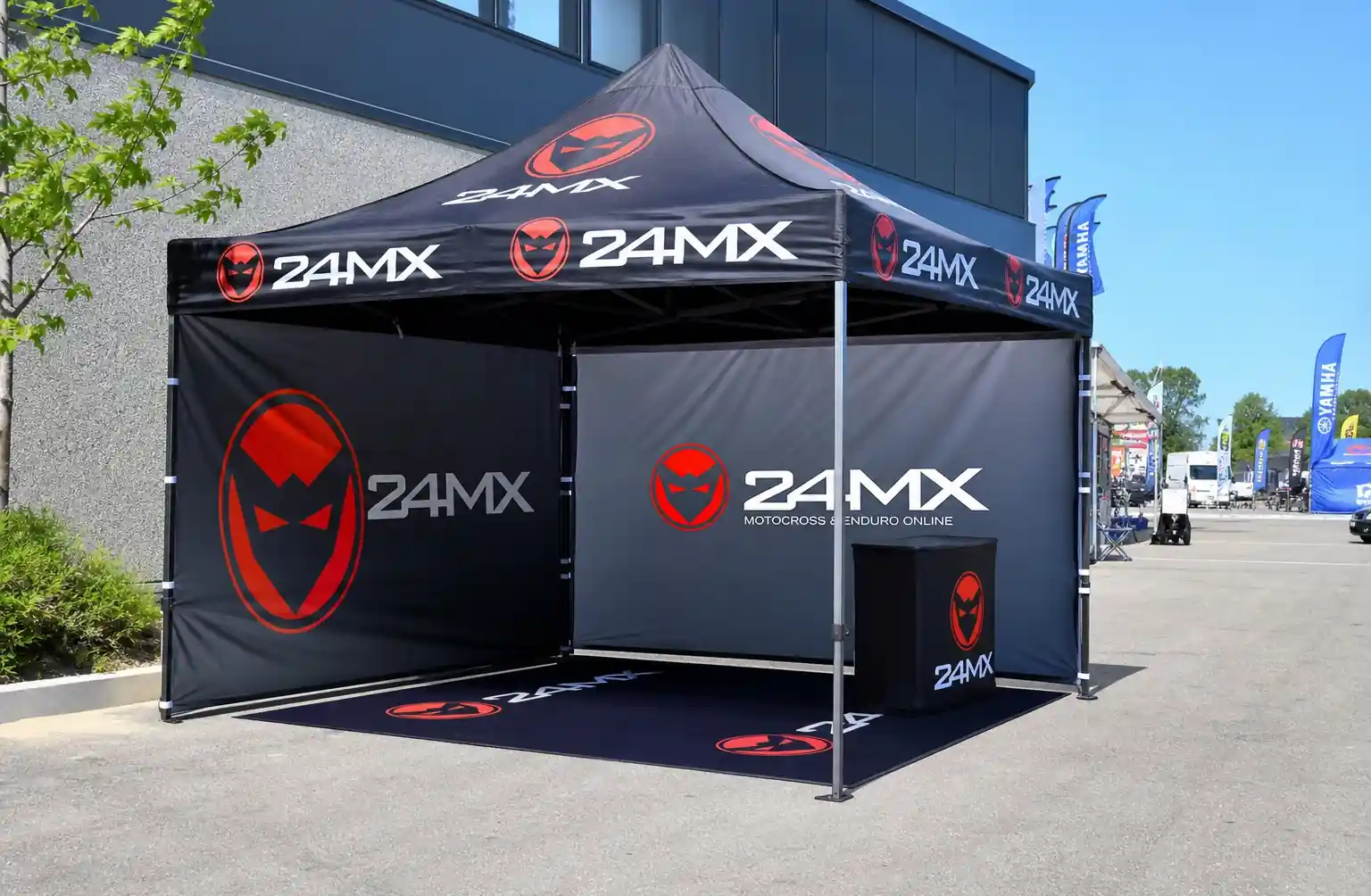 Custom branded graphics and panels on roadshow marketing tent
Visual consistency across markets separates professional campaigns from amateur executions. Branding must survive transport and weather while maintaining color accuracy.
| Method | Durability | Setup | Cost | Application |
|---|---|---|---|---|
| Printed Fabric Panels | Excellent | Pre-installed | $$$ | Permanent tour branding |
| Tension Fabric Systems | Very good | Quick-change | $$$$ | Multiple campaign versions |
| Vinyl Graphics | Good | Moderate | $$ | Short tours (5-10 cities) |
Digitally printed fabric panels with dye-sublimation provide best longevity for multi-city tours. UV-stable inks maintain color fidelity through 200+ hours sun exposure. Panels attach via keder rail systems enabling tool-free installation in 15-20 minutes.
Quality control protocols prevent inconsistencies. Photograph completed structure at first deployment from eight positions at 20m distance. These reference images enable field crews to replicate exact configuration at subsequent stops.
6. Multi-City Permit Management
Permit failures cause 30-40% of roadshow delays. Different jurisdictions require varying documentation and processing timelines. Professional operations allocate 4-8 weeks for permit acquisition.
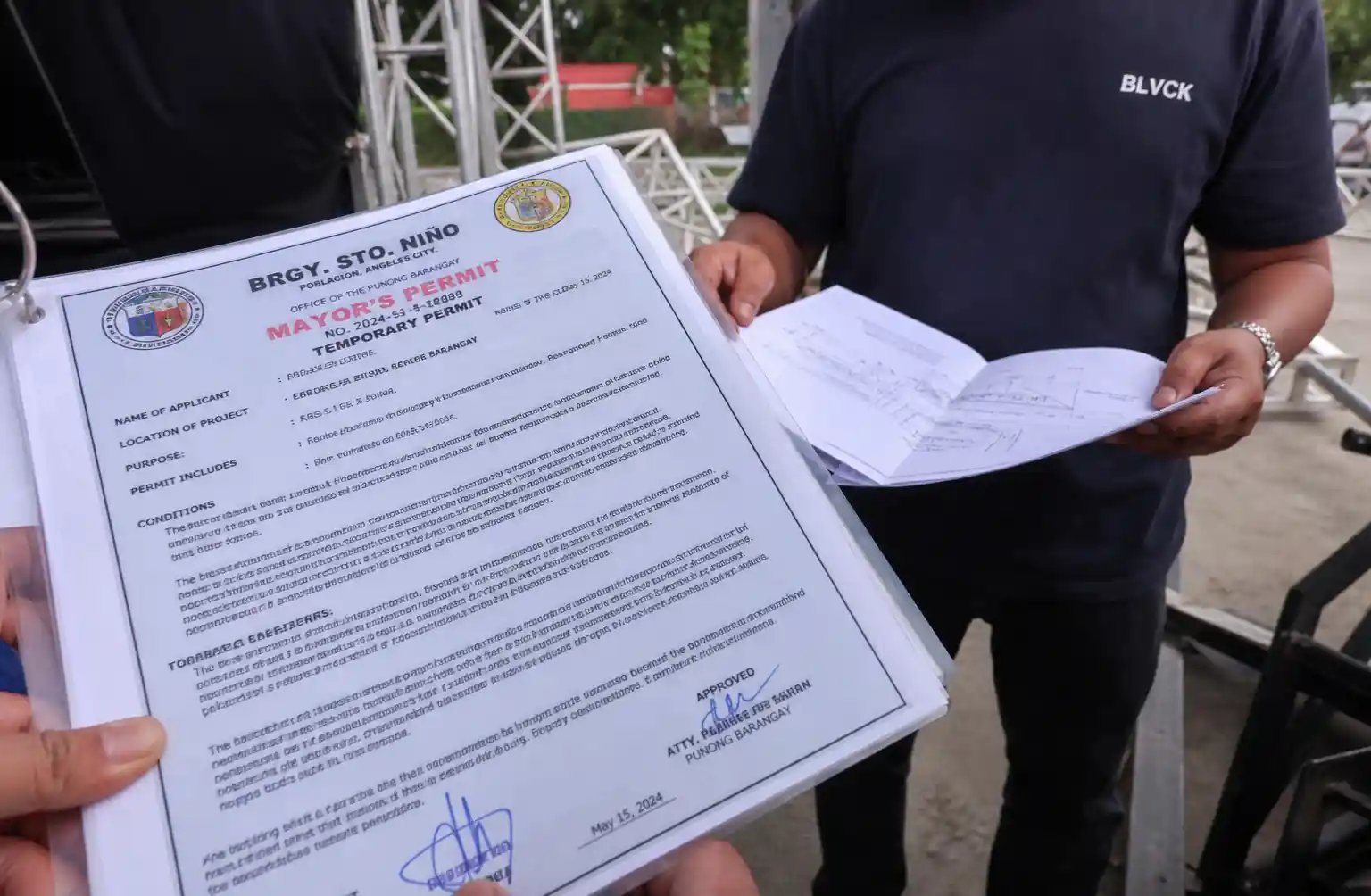
Event permit documentation and structural certification for roadshow tent
Public spaces require municipal permits, liability insurance (minimum £5M), structural certifications, and fire compliance. Processing needs 4-6 weeks in most European and North American jurisdictions.
Private venues need venue approval but simplified permitting (2-3 weeks). Indoor venues waive structural permits but enforce strict fire safety codes requiring fabric flame certifications (B1/M2 ratings).
Regional Permit Complexity:
- UK/Ireland: Local council permits (3-4 weeks)
- Germany/France: Stringent structural certs (5-6 weeks)
- UAE/Qatar: Multiple ministry approvals (6-8 weeks)
- Southeast Asia: Variable city requirements (2-6 weeks)
Hire local permit expeditors for complex markets. Dubai activations benefit from agencies with pre-established municipality relationships, reducing approval from 8 to 4 weeks at £2000-3500 per location.
7. Staff Training and Quality Control
Inconsistent execution erodes brand value. Perfectly engineered structures present poorly when assembled incorrectly or staffed inadequately.
Lead crew must complete minimum 8-hour training covering structure assembly, safety protocols, brand standards, quality checkpoints, and emergency procedures. Document training with certification, requiring crew demonstrate competency before market deployment.
Implement five mandatory inspection points: post-frame assembly (structural integrity), post-roof (weather sealing), post-branding (visual accuracy), pre-opening (safety compliance), and daily opening (readiness). Document checkpoints with timestamped photos.
Remote supervision reduces quality variance. Equip crew leads with smartphones running quality control apps featuring photo upload, checklist completion, and real-time communication with campaign coordinators.
Consistency protocols matter more than initial training quality. A mediocre setup executed identically across 20 markets delivers better brand impact than excellent setups varying significantly.
8. Cost Analysis and ROI Optimization
Multi-city roadshows demand significant capital investment. A 12-city European campaign typically requires £45,000-85,000 all-in budget.
| Cost Category | Budget Range | Percentage | Optimization |
|---|---|---|---|
| Tent Structure | £12,000-25,000 | 25-30% | Purchase vs rental after 8+ cities |
| Transport/Logistics | £9,000-18,000 | 20-25% | Route optimization |
| Setup Labor | £8,000-15,000 | 18-22% | Efficiency training |
| Permits/Insurance | £5,000-10,000 | 10-15% | Early bulk processing |
| Branding | £4,000-8,000 | 8-12% | Reusable systems |
| Staffing | £7,000-14,000 | 15-20% | Local hiring |
Rental suits 1-3 city tours (£3,000-5,000 per city for 150 sqm). Purchase becomes cost-effective at 8+ cities. Owned structures amortize over 20-30 deployments (3-5 years), reducing per-activation cost to £800-1,200.
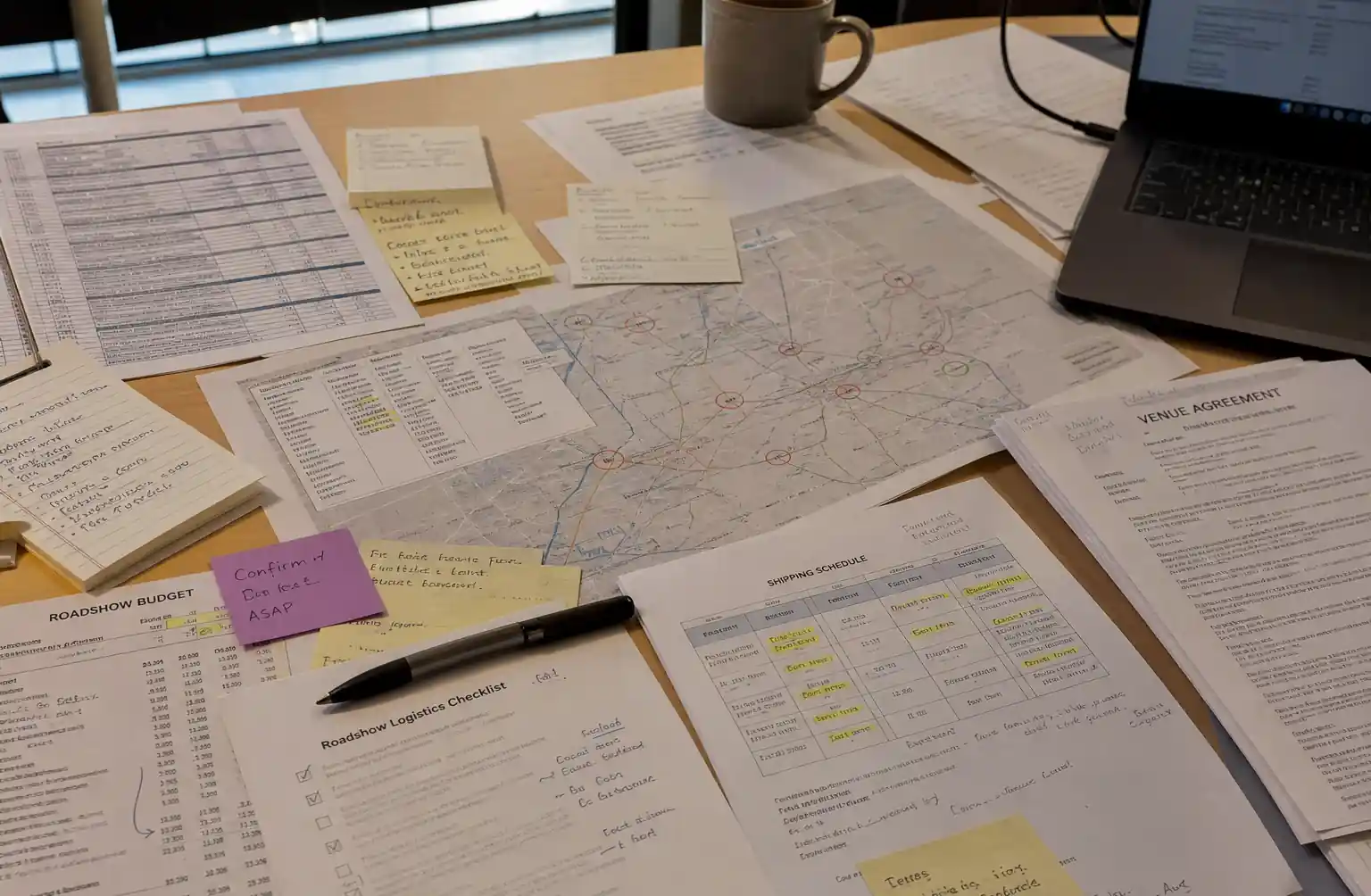 Budget planning and cost analysis for multi-city brand roadshow campaign
Well-trained four-person crews complete setup in 3-4 hours versus untrained six-person teams requiring 6-8 hours. Labor savings of £400-600 per activation multiply into £4,000-9,000 across tours.
ROI metrics should track beyond impressions. Measure cost per qualified lead, conversion rates, and customer lifetime value. Campaigns generating 200-300 qualified leads per city at £150-200 per lead demonstrate strong ROI.
FAQ
How long does it take to plan a 10-city brand roadshow?
Professional campaigns require 12-16 weeks minimum planning: 4-6 weeks for permits across jurisdictions, 3-4 weeks for structure fabrication and branding, 2-3 weeks for logistics coordination, and 2-3 weeks for crew training. Rush timelines increase costs 40-60%.
What's the minimum team size for a mobile roadshow?
A 150 sqm activation requires seven personnel: four setup crew, one activation manager, two brand ambassadors. Smaller 50-75 sqm structures operate with five: three crew, one manager, one ambassador.
How do you maintain branding consistency across weather conditions?
Use UV-stabilized printed fabrics rated for 200+ hours sun exposure, specify color compensation for regional lighting, protect graphics during transport with padded cases, conduct photo documentation at first deployment, and implement pre-opening inspection verifying alignment.
What happens if permits are denied in one market?
Build 2-3 week buffer into tour schedule allowing alternate venue sourcing, maintain relationships with multiple venue types per city, work with local permit expeditors, and consider venue pre-approval before finalizing routing.
Can the same tent work across tropical and temperate climates?
Yes, with proper specifications: UV-resistant fabrics (850g/sqm minimum), anodized aluminum frames, stainless steel components, weather-appropriate anchoring, and climate control for -5°C to 40°C range.
What's the ideal duration per city stop?
3-5 days per city optimizes consumer reach versus logistics costs. Single-day stops provide insufficient penetration. Stops exceeding 7 days show diminishing returns. Weekend-spanning schedules (Thursday-Sunday) capture weekday and weekend demographics.
Conclusion
Successful brand roadshows demand engineering rigor, logistical precision, and operational discipline. Campaigns delivering consistent ROI treat mobile marketing as deployment engineering, not event replication.
Start with infrastructure specifications matched to tour scope: modular systems for 15+ cities, wind-rated structures for outdoor venues, transport-optimized components fitting standard freight. Allocate 12-16 weeks for comprehensive planning including permit acquisition, logistics coordination, and quality system development.
The brand roadshow solutions we engineer incorporate structural durability, transport efficiency, and rapid deployment protocols proven across continental campaigns. For specialized applications, explore our industrial storage solutions for equipment warehousing or clear tent structures for premium activations.