


Event Tent Flooring Options: Complete Guide to Ground Solutions
Every outdoor event faces the same challenge: uneven ground, mud risk, and guest comfort. You need flooring that installs fast, stays stable, and looks professional. Industry data shows that 67% of event planners consider flooring the most critical accessory after the tent structure itself.
Table of Contents
Why Event Tent Flooring Matters
You protect your investment when you install proper flooring. Tent floors prevent ground moisture from ruining equipment and keep guests comfortable throughout your event. Without flooring, you risk ankle injuries on uneven terrain and mud tracking that damages rental furniture.
Professional flooring transforms any site into a stable venue. You can host events on grass, sand, or gravel with confidence. The right floor system distributes weight evenly, protects the tent fabric from ground punctures, and creates a level surface for tables and chairs.
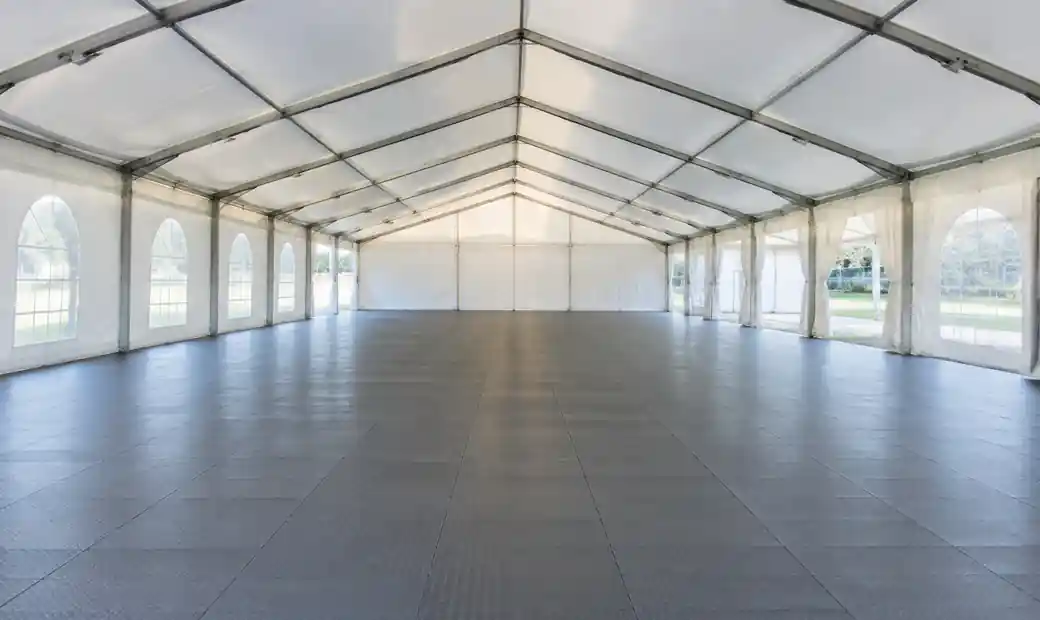 Professional tent flooring installation for outdoor event showing level stable surface
Types of Event Tent Flooring
Interlocking Foam Tiles
You install these tiles without tools or adhesives. Each tile connects via edge tabs that snap together in minutes. Foam tiles work best for short-term events because they cushion feet and reduce fatigue. You can cut them to fit irregular tent shapes using a utility knife.
Standard tiles measure 24x24 inches and stack easily for transport. They provide thermal insulation on cold ground and muffle sound in exhibition settings. However, foam compresses under heavy furniture, creating visible dents after 3-4 days of use.
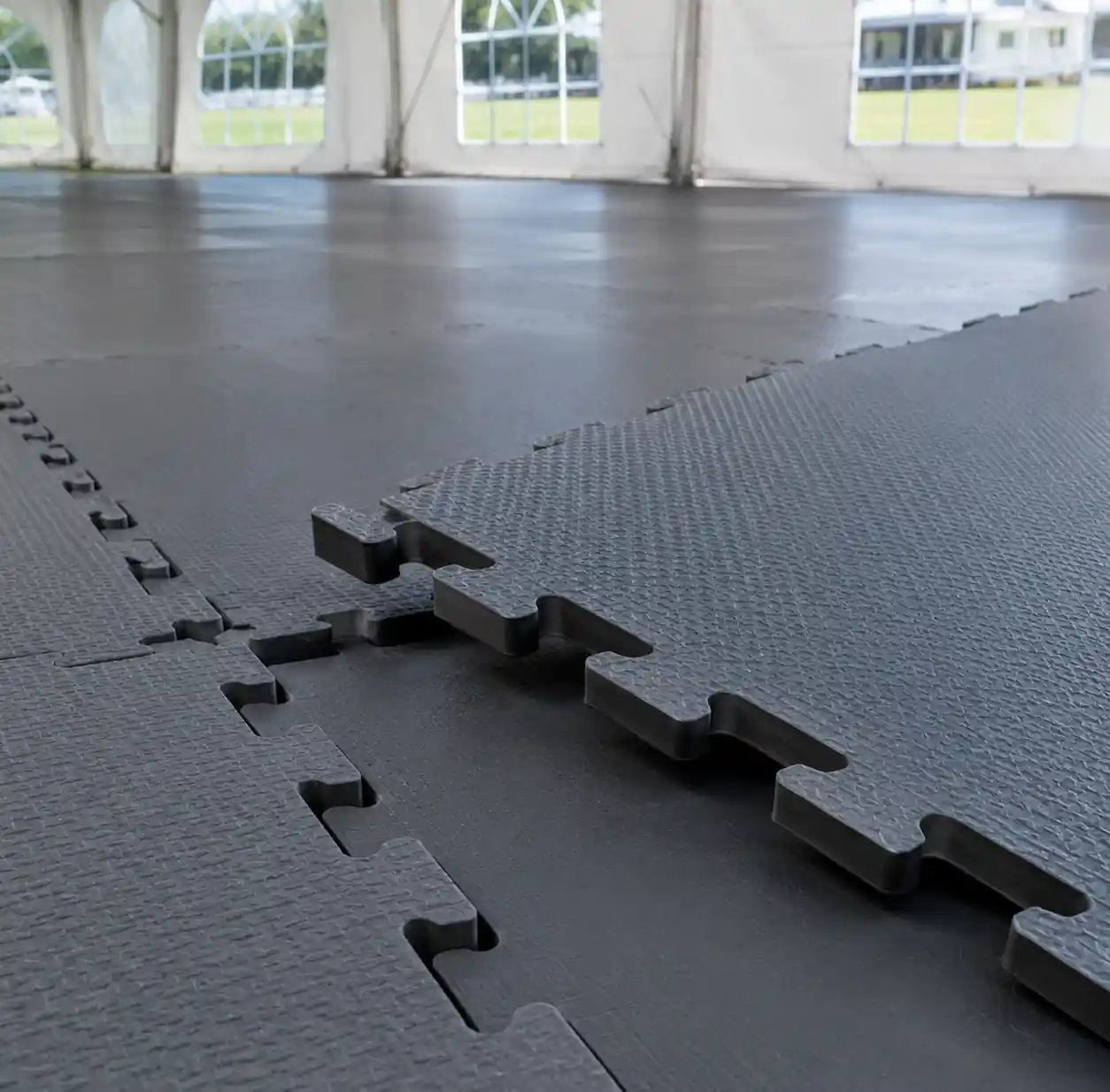 Interlocking foam tiles installed as event tent flooring with edge connection system
Wood Panel Systems
You achieve a premium look with wood panels or plywood sheets. These rigid surfaces support heavy equipment and create a dance-floor-quality finish. Installation requires a subframe of joists or support beams to keep panels level and prevent bouncing.
Wood systems handle concentrated loads better than any alternative. You can anchor staging, buffet stations, and bar setups without reinforcement. The main drawback: installation takes 4-6 hours for a 40x60 tent, and you need a crew of 3-4 workers.
Modular Plastic Tiles
You get maximum durability with commercial-grade plastic tiles. These interlocking systems withstand forklift traffic and heavy booth displays at trade shows. Tiles feature drainage channels that prevent water pooling during rain.
Plastic tiles install faster than wood and last through 200+ events with minimal wear. You can mix colors to create walkways, branding patterns, or safety zones. They cost more upfront but deliver the lowest per-event expense over five years.
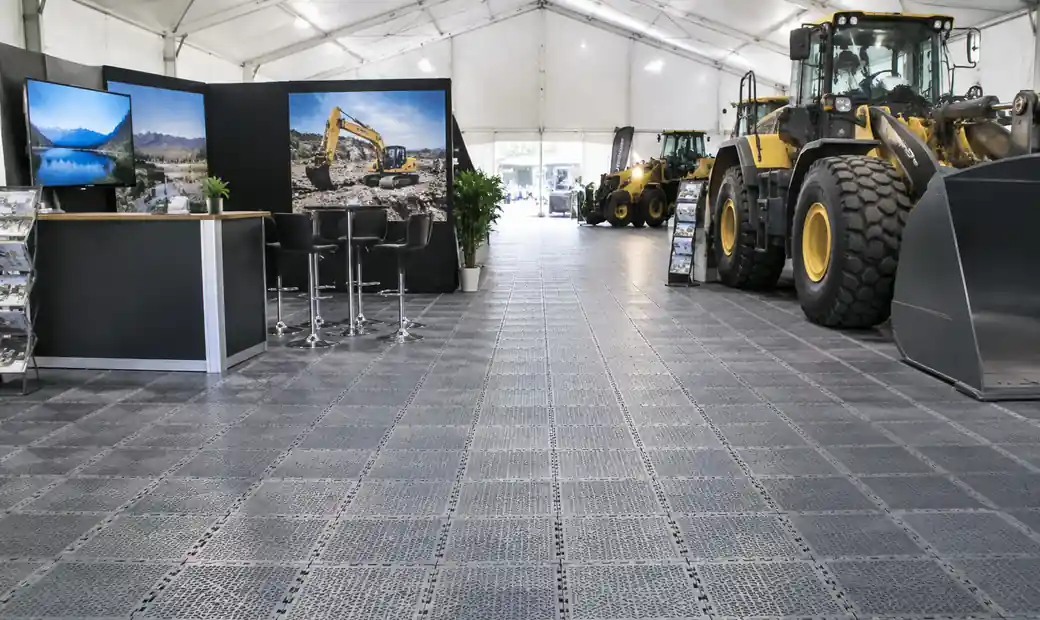 Commercial-grade modular plastic tile flooring system in exhibition tent with drainage channels
Carpet Mat Systems
You create instant elegance with carpet mats designed for outdoor use. These mats feature waterproof backing that blocks ground moisture and non-slip surfaces that meet ADA requirements. Roll-out carpet covers large areas quickly, making it ideal for wedding ceremonies and VIP receptions.
Premium carpet systems include padding that hides minor ground irregularities. You can choose from dozens of colors to match event themes. Carpet shows wear faster than hard surfaces and requires professional cleaning between uses.
Ground Condition Analysis
Grass and Lawn Sites
You need ground protection layers on grass to prevent soil compaction and turf damage. Grass provides natural cushioning but becomes slippery when wet. Install flooring directly on healthy, dry grass for events under 3 days. For longer setups, place geotextile fabric first to protect root systems.
Grass tolerates light foot traffic without subflooring. You must add plywood or rigid panels under catering stations, stages, and any area with wheeled equipment. Slopes greater than 3 degrees require leveling shims or graded fill before flooring installation.
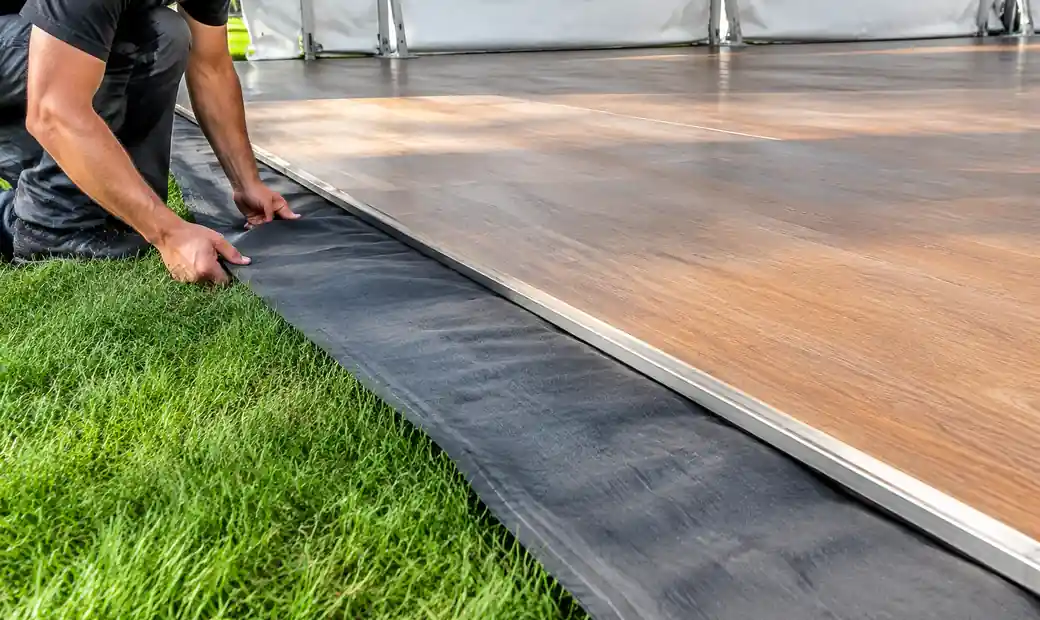 Event tent flooring being installed on grass lawn surface with ground protection layer
Sand and Beach Locations
You face instability challenges on sand that require specialized techniques. Sand shifts under load, causing floors to sink unevenly. Create a stable base by compacting sand with a plate tamper, then laying geotextile fabric to prevent sinking.
Modular plastic tiles work best on sand because their open bottom design allows drainage and prevents suction. You need 30% more installation time on sand versus solid ground. Anchor perimeter tiles with ground stakes driven at 45-degree angles.
Concrete and Asphalt
You have the easiest installation conditions on paved surfaces. Concrete provides perfect load distribution and needs no subflooring. Simply clean the surface and roll out carpet or snap together tiles directly.
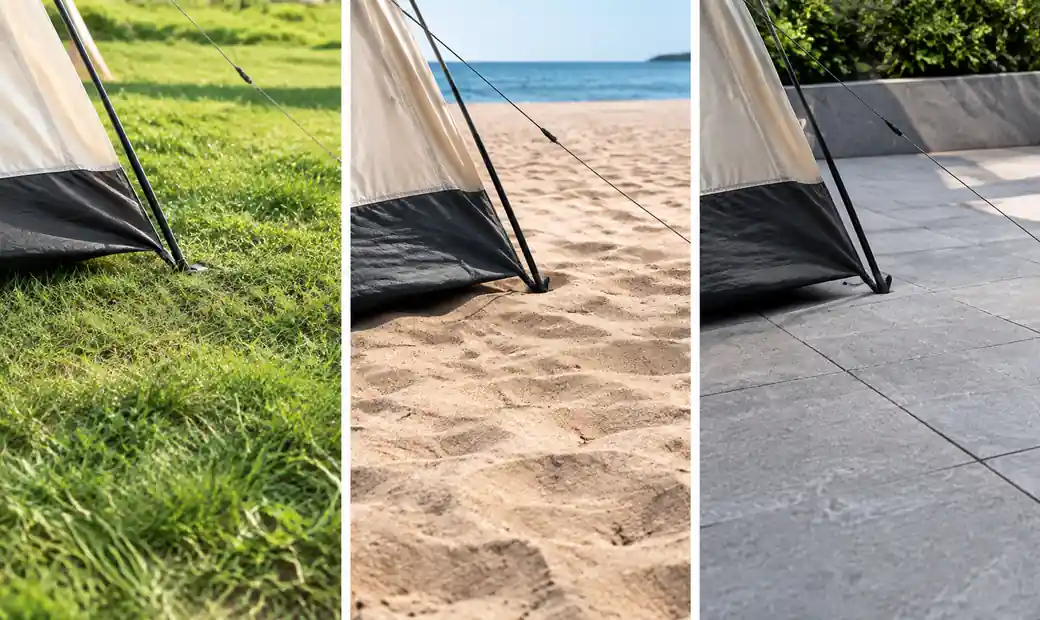 Comparison of different ground conditions for tent flooring including grass sand and concrete
Protect existing pavement from scratches by using foam-backed carpet or rubber-bottomed tiles. You can install 1,000 square feet of flooring in under 2 hours on concrete. Watch for drainage slopes—water flows toward tent edges, so position floor seams perpendicular to the slope.
| Ground Type | Preparation Time | Best Flooring | Special Requirements |
|---|---|---|---|
| Grass (flat) | 30 min | Carpet, Foam Tiles | Geotextile for events over 3 days |
| Grass (sloped) | 2-3 hours | Wood Panels | Leveling shims, joists |
| Sand/Beach | 3-4 hours | Plastic Tiles | Compaction, fabric underlayment |
| Concrete | 15 min | Any Type | Surface cleaning only |
| Gravel | 1-2 hours | Plywood + Carpet | Grading, fabric layer |
Cost and Installation Comparison
You balance budget against performance when selecting flooring. Entry-level foam tiles cost $2-4 per square foot and install in 1-2 hours for a standard 1,200 sq ft tent. Mid-range carpet systems run $4-7 per square foot with similar installation speed.
Premium wood flooring reaches $8-15 per square foot including subframe, and installation takes a full day. Commercial plastic tiles cost $7-12 per square foot but last 5-10 years versus 2-3 years for foam or carpet.
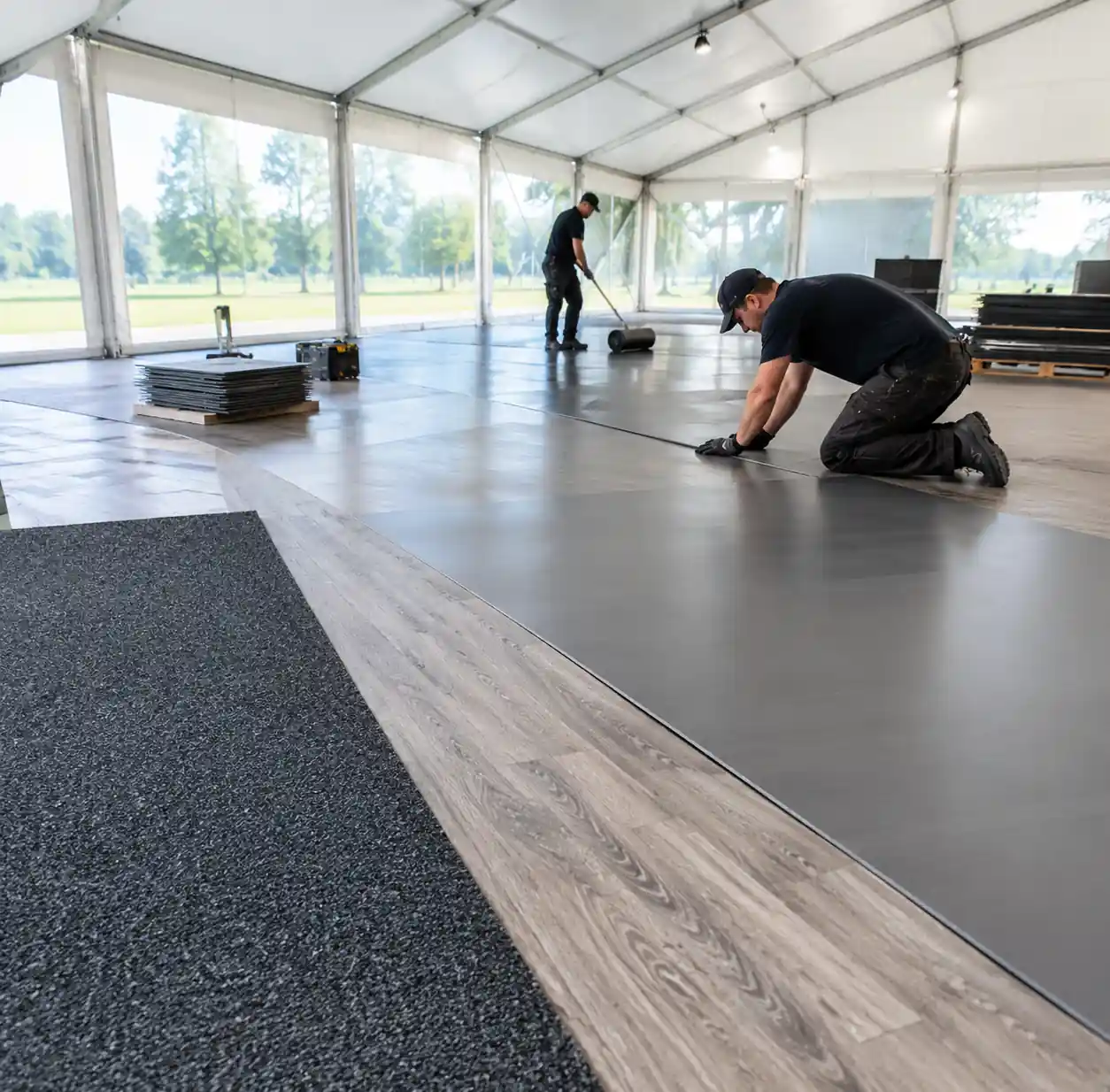 Professional tent flooring installation showing different flooring types and materials
Calculate total cost including labor, transport, and cleaning. A 40x60 tent (2,400 sq ft) with foam tiles costs $6,000-9,000 installed. The same space with wood flooring runs $19,000-36,000. Plastic tiles fall in the middle at $16,000-28,000 but amortize to lowest cost per event.
| Flooring Type | Cost per sq ft | Installation Time (2,400 sq ft) | Lifespan | Best For |
|---|---|---|---|---|
| Foam Tiles | $2-4 | 2-3 hours | 2-3 years | Short-term events, budgets |
| Carpet Systems | $4-7 | 2-4 hours | 2-3 years | Weddings, galas, VIP events |
| Wood Panels | $8-15 | 6-8 hours | 5+ years | Dance floors, premium events |
| Plastic Tiles | $7-12 | 3-5 hours | 8-10 years | Trade shows, repeat use |
Wheelchair Accessibility Requirements
You must meet ADA standards for public events. Install ramps with maximum 1:12 slope at all tent entrances. Flooring surfaces cannot exceed 1/2 inch height variation over any 4-foot span.
Wheelchair users need firm, slip-resistant surfaces with minimal gaps between tiles. Foam tiles compress too much under wheelchairs—use rigid plastic or wood systems instead. Carpet works if pile height stays under 1/2 inch and backing prevents shifting.
Create 36-inch minimum width pathways throughout the tent. You need 60-inch diameter turnaround spaces at dead ends and restroom entries. Mark accessible routes with contrasting floor colors or textures.
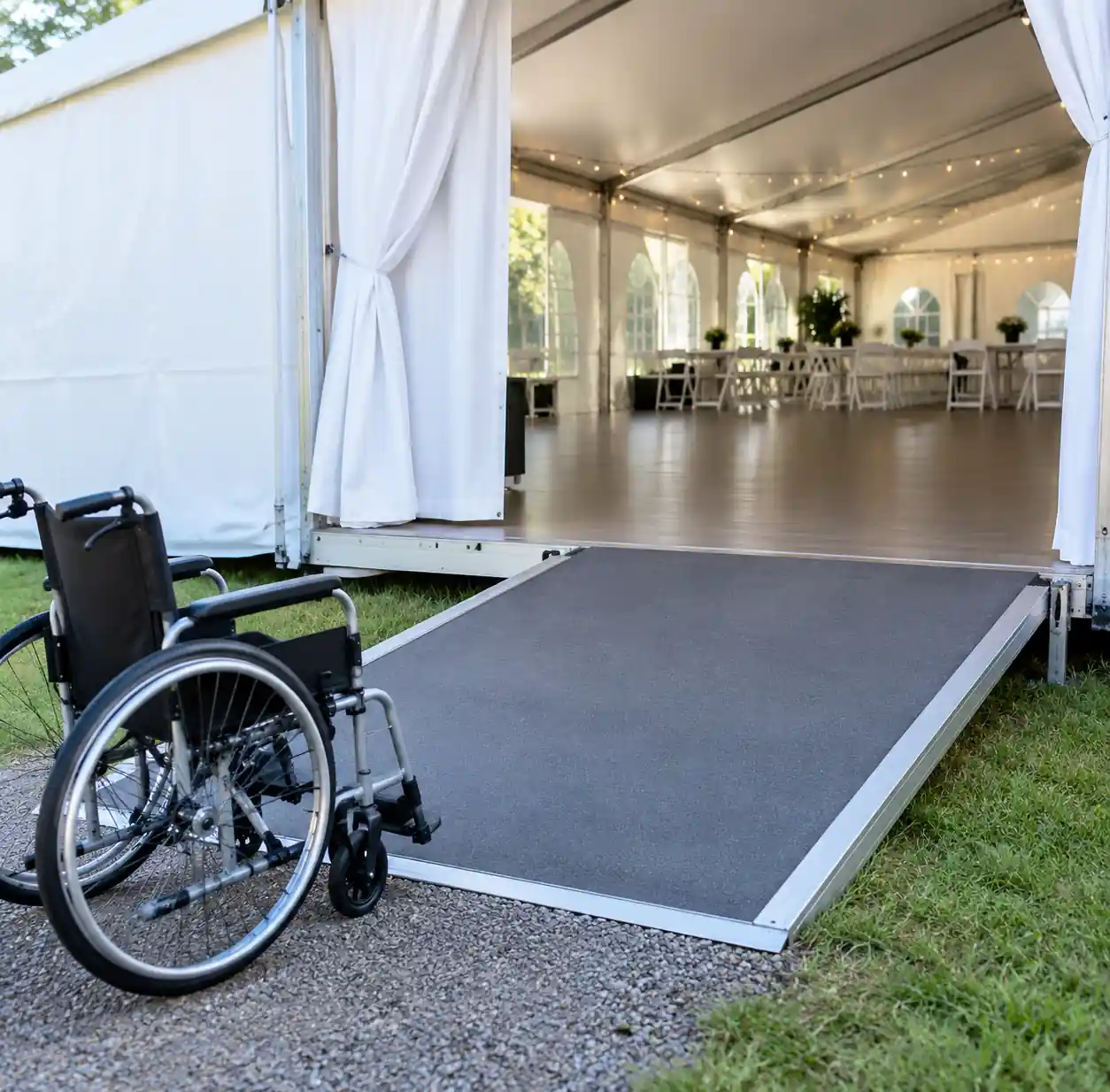 Wheelchair accessible tent flooring with entrance ramp meeting ADA compliance standards
Weather Protection Strategies
You prevent moisture damage by installing vapor barriers under all flooring. Use 6-mil polyethylene sheeting that overlaps by 12 inches at seams. Tape seams with waterproof construction tape.
Rain protection requires raised flooring or drainage channels. Plastic tiles with built-in drainage handle light rain without modification. For heavy rain, elevate floors 2-3 inches on support joists to create airflow underneath.
Cold weather demands insulated flooring to prevent condensation. Foam tiles provide R-2 insulation value, keeping floors 10-15°F warmer than ground temperature. This stops moisture from condensing on the floor surface during events with heating.
Hot weather creates expansion issues. Leave 1/4-inch gaps every 20 feet in wood flooring to allow thermal expansion. Plastic tiles have built-in expansion joints. Light-colored surfaces reflect heat and stay 20°F cooler than dark flooring.
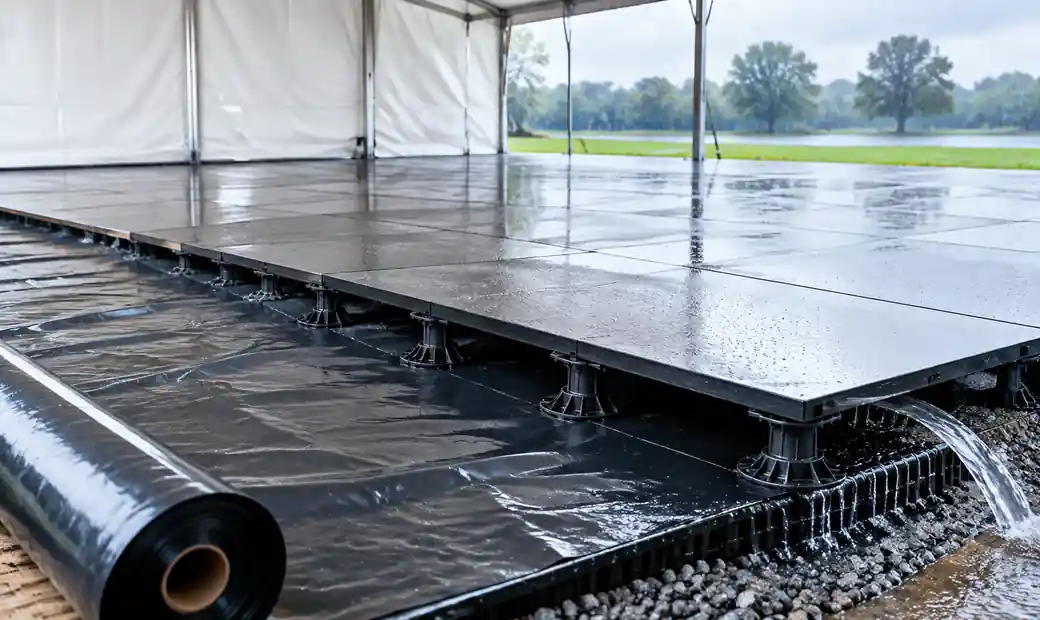 Weather-protected tent flooring installation with vapor barrier and drainage system
FAQ
How long does tent flooring installation take?
You can install 1,000 square feet of interlocking tiles in 1-2 hours with a two-person crew. Wood panel systems with subframes require 6-8 hours for the same area. Professional installers work faster but budget a full day for wood floors in tents over 3,000 square feet.
Can I install flooring on sloped ground?
You can handle slopes up to 3 degrees with shimmed joists under rigid flooring. Steeper slopes need graded fill or terraced platforms. Flexible flooring like carpet conforms to minor slopes but creates tripping hazards beyond 2 degrees. Always check local codes for maximum allowable slope at public events.
What's the most cost-effective flooring for multi-day events?
You get best value from modular plastic tiles for events lasting 4-10 days. Initial cost runs higher than foam, but plastic tiles don't compress, clean easily, and reuse for years. For single-day events, foam tiles offer lowest total cost. For premium weddings, carpet delivers appearance worth the expense.
Do I need subflooring under carpet?
You need subflooring on grass, sand, or gravel to create a stable base. Plywood sheets over geotextile fabric work well. On concrete or packed dirt, you can lay carpet directly if the surface is smooth and level. Subflooring adds cost but prevents carpet wrinkling and extends lifespan.
How do I protect flooring in high-traffic areas?
You should use commercial-grade plastic tiles at entrances, buffet lines, and bars where traffic concentrates. Place walk-off mats just inside tent entrances to capture dirt. For carpeted events, overlay plastic tile runners in high-traffic zones. This hybrid approach costs 15-20% more but prevents premature wear.
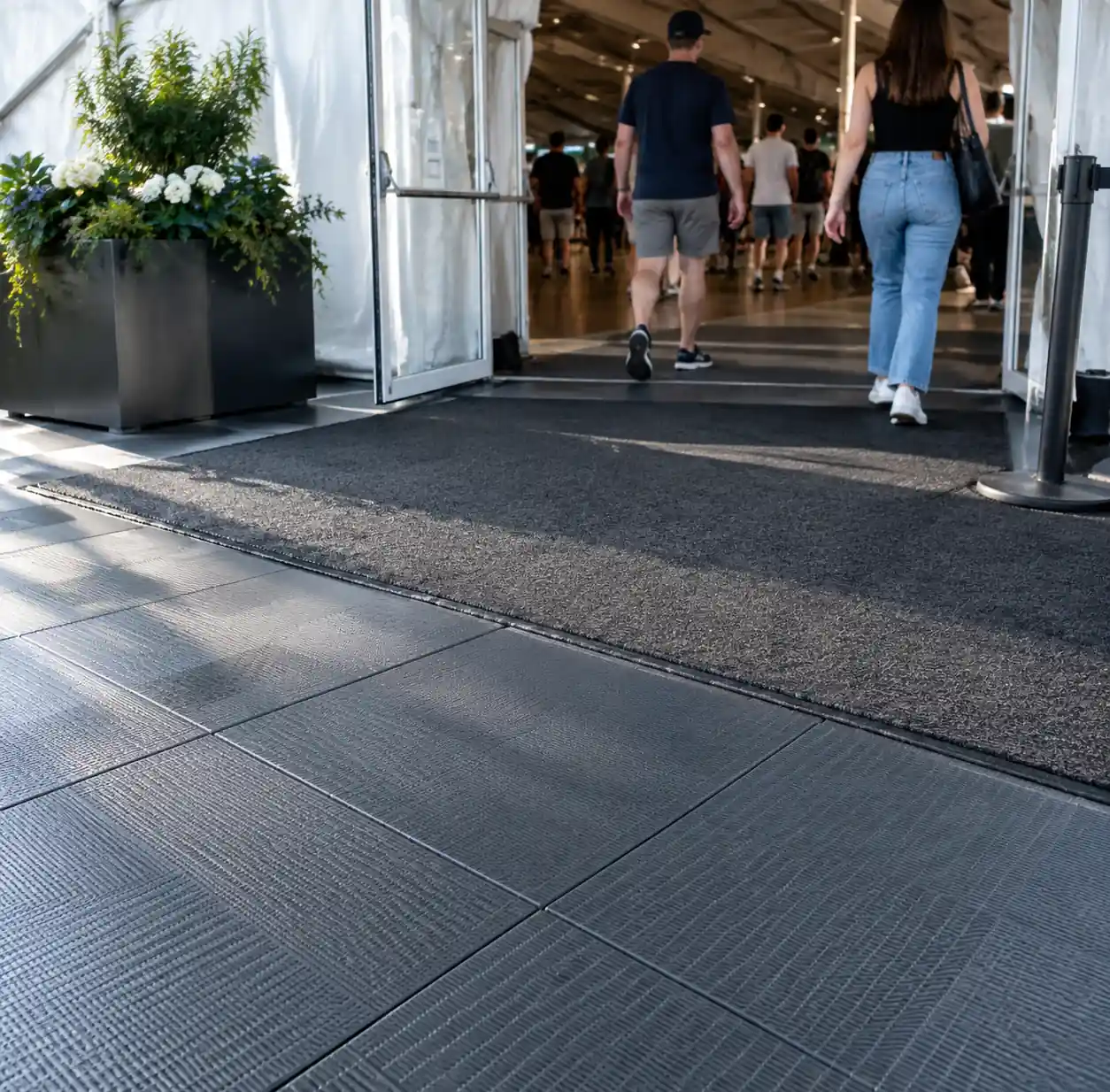 High-traffic tent entrance area with durable flooring and protective mats
Conclusion
You now understand how to select and install event tent flooring for any ground condition. The right flooring system balances your budget, timeline, and performance requirements. Foam tiles deliver fast, affordable solutions for short events. Plastic tiles provide maximum durability for trade shows and repeat use. Wood creates premium surfaces for upscale occasions.
Velaria Spatia supplies complete ground solutions for wedding receptions, corporate exhibitions, and VIP events. Our engineering team analyzes your site conditions and recommends optimal flooring systems that install quickly and perform reliably. We integrate flooring with tent anchoring systems to ensure structural stability regardless of ground type.
Ready to specify the right flooring for your next event? Contact our technical team for site-specific recommendations and installation support. We provide detailed load calculations, accessibility compliance verification, and weather protection strategies tailored to your venue.